

Tier 7 · RX Series 1 of 11
Camber Steady Plus
The most technologically advanced progressive lens tailored for you
Overview
Made for you, made to order.
We live in a dynamic and ever-changing society. Our lives are fast paced, and the digital age is here to stay.
Camber Steady Plus Progressive lenses adapt to the demands of modern life. Their technology meets the visual needs of the most active presbyopes, who demand clear and stable vision, even when they’re engaged in highly dynamic activities.
The benefits
- Superior visual acuity
- Improved quality of vision in the near zone
- Unbeatable aesthetics for plus lenses
- Precise and comfortable focus for all working distances in any direction of gaze
- Near elimination of peripheral blur
- Superior visual quality for viewing digital devices
- Higher image stability for reduced swim effect
- Better performance in binocular vision at near and intermediate
Technologies
Technologies.
- Camber
- Spatial Vision
- Eye Focus Profile
- Ray Tracing
- Binocular Vision
- Visual Stability
- Lifestyle
- Fitting Configuration
These principles underpin IOT’s cutting-edge lens optimization technologies, Camber Technology, IOT Digital Ray-Path 2 Technology and Steady Plus Methodology.
Camber
Dual-sided lens with extra-large visual zones for unbeatable optics and aesthetics.
“Unparalleled vision, especially in the near zone”
Pushing the boundaries of free-form technology, the lens’s special geometry enables wider fields of view and sharper vision, especially in the reading zone.
The variable base curve achieves a better balance between visual quality and lens thickness, particularly for high prescriptions.
This results in lenses with the highest level of visual comfort and clarity, particularly for reading and other close-up activities.
The best visual acuity in the near zone. Camber Steady Plus Progressive has a patented, continuously increasing base curve, ideal for the increasing power profile of a progressive lens. Lens with continuous power gradation. Patent: WO2011093929 / US8042941
Spatial Vision
Use of accommodation for improved spatial vision and super dynamic vision.
“Naturally good vision, even when you’re on the move”
Spatial Vision Technology optimizes the range within which an object can be moved closer to or farther away from the eye without a noticeable change in the focus of the image. This improves the eye’s ability to focus on objects both near and far, resulting in exceptional sharpness perception and extended areas of focus.
This technology ensures that wearers experience clear and sharp vision, even in dynamic environments where objects are constantly changing distances from the eye. It enables smooth and rapid transitions across visual zones, especially when looking down to focus on nearby objects.
It enhances your spatial vision, providing extended areas of clear focus.
Eye Focus Profile
Eye Focus profiling for flawless vision.
“Flawless vision from any angle”
Eye Focus Profile Technology maximizes the clear viewing area and significantly reduces perceived blur in the peripheral areas of the lens.
By taking into consideration the wearer’s accommodative reserve, it effectively minimizes oblique aberrations, achieving an absolute reduction in defocus and increasing the visual performance of the lenses.
Ray Tracing
Optimum vision across the entire lens.
“Say goodbye to head tilting in search of the exact spot – regardless of distance and direction of gaze”
Thanks to point-by-point optimization over the entire lens surface, Ray Tracing Technology provides precise vision at every distance and in every direction of gaze. The perceived power distribution is consistent, regardless of prescription or frame shape.
Wearers enjoy a more natural visual experience with much less distortion than a conventional digital lens.
Binocular Vision
Overlap in perception for a single visual image.
“Perfect synchronization of both eyes”
Binocular Vision Technology ensures a symmetrical design that enables clear image and vision, regardless of any difference in prescriptions, for both lenses in intermediate and near areas.
This ensures that the wearer experiences a comfortable and balanced vision, with optimal performance for all activities.
Visual Stability
Attain perfect vision stability, always.
“Exuding confidence while on the move”
Visual Stability Technology significantly reduces the swim effect when moving by controlling the mean power error.
This virtually eliminates image distortions and enhances image stability, providing the wearer with a comfortable and clear vision experience.
Lifestyle
Fitted perfectly to each wearer’s lifestyle.
“Your lifestyle is unique, just like you”
Lifestyle Technology adapts to the changing vision needs of wearers at every stage of their lives and lifestyles.
The lens suits the wearer’s daily activities with a choice of one of the four custom-designed options with a unique power distribution that enhances visual areas for balance, distance, intermediate or near activities.
Choosing the best custom design based on your patient’s lifestyle ensures they receive an all-purpose lens tailored for maximum satisfaction and visual comfort.
- Camber Steady Plus Progressive | Balance Vision – A versatile lens design, which balances distance, near and intermediate fields. Designed for active and demanding presbyopes, whether experienced or new progressive lens wearers.
- Camber Steady Plus Progressive | Near Vision – Option with wider near zone, ideal for reading, crafting or other activities that involve focusing on objects close at hand. Suitable for experienced or new progressive lens wearers.
- Camber Steady Plus Progressive | Distance Vision – Option with panoramic distance zone, ideal for active and outdoor lifestyles. Suitable for experienced or new progressive lens wearers.
- Camber Steady Plus Progressive | Intermediate Vision (first-time presbyopes) – A softer progressive design option with a wider intermediate zone, ideal for new presbyopes or wearers who have experienced difficulties with other progressive lenses.
Fitting Configuration
Fitting Configuration.
“Fitted perfectly to you”
Fit parameters: MPD, PANTO, ZTILT, BVD, VBOX, HBOX, HT, DBL.
- Individual Fit – Personalized to perfection. “Individual and one-of-a kind, just like you” – Optimizes the vision zones based on the unique data of the wearer, including their prescription, facial morphology, frame shape, and use position. This allows us to create a fully personalized lens.
- Frame Fit – Adaptation in next to no time. “Your style, your choice” – Regardless of the shape or size of the frame, our technology adjusts the lens design structure to provide optimal performance.
- Lens Fit – Unbeatable combination of aesthetics and lightness. “A flat lens design, for a natural look” – Optimizes the aesthetic appearance of the lens by utilizing the optimal base curves and thinning prism, resulting in the thinnest possible lenses, even with a high prescription. Through thickness optimization, our technology provides a sleek and modern aesthetic for the wearer.
Camber Technology
Camber Technology in depth
Camber technology combines complex surfaces on both sides of the lens to provide excellent visual correction.
Inspired by stability
Camber Steady is a premium progressive lens that provides superior image stability even in dynamic conditions. Its unique lens design architecture combined with IOT’s proprietary calculation technology, Steady Method, represents a true innovation in progressive lenses.
Progressive lenses have been available for over 50 years. New technological advances in manufacturing and software have allowed the ophthalmic lens industry to create infinite lens designs, fully personalized and adapted to the patient’s lifestyle. Optimization technologies have evolved that reduce oblique astigmatism to minimal limits. Specialty lenses, designed for a wide variety of tasks and situations are broadly available. With all of these changes, what else can be improved?
Despite advancements made in progressive lens design, some patients still experience a swim effect while wearing them, especially in dynamic conditions. Swim is a non-stable perception of the surroundings that causes discomfort and reduces overall lens satisfaction, making adaptation more difficult. It is in the reduction of swim that there is room for improvement.
Camber Steady was inspired by the Steadicam, a stabilizer for motion picture cameras that allows for a smooth shot, even if the camera moves over irregular surfaces. Camber Steady was designed to deliver superior image stability to the wearer the same way that Steadicam allows a camera to capture sharp and stable footage while it is in motion. Camber Steady delivers superior image stability and better peripheral vision to perfectly capture any detail, even in dynamic conditions. A superior lens that improves the patient’s overall satisfaction, Camber Steady is completely adapted to life movements.
Based on optometric evidence
It’s not just about inspiration for IOT, a technology company focused on research and innovation. Camber Steady is based on an in-depth study of the lens power variation and its distribution, and how this is related to a patient’s visual quality. Extensive wearer trials were conducted to find an optimum lens power distribution that resulted in less distortion and defocus, and therefore improved overall satisfaction.
Camber Steady is the result of approaching lens design development from a completely new angle based on measurable optometric information that was not previously available.
Three components in synergy
The innovative lens blank is only the beginning. When the unique front surface is combined with a sophisticated back-side digital design, both surfaces work together to become the Camber finished lens. Camber lenses have three essential components:
- The Camber blank: with variable base curve by Younger Optics, the Camber lens blank improves on the spherical lens blank, by offering a continuously increasing base curve that is better suited for progressive prescriptions.
- The Camber Rx design: created with IOT Digital Ray-Path 2 Technology and Steady Methodology, Camber lens designs are mathematically compensated for peripheral aberrations and include the intelligent use of the wearer’s accommodation to drastically reduce aberrations across the entire field of vision. They also incorporate strict control of mean power to practically eliminate spherical error in lateral areas of the lenses, resulting in improved lateral vision and superior image stability.
- Personalization parameters: the Rx design computation is further enhanced, when desired, by a complete set of individualization parameters that take into consideration the unique attributes of the frame and the preferences of the wearer. The result is a finished lens that is comprehensively customized for each individual patient.
Background: accommodation and presbyopia
In order to understand how Steady Method was created and how it works in detail, it is essential to review the role of accommodation and its effect.
Presbyopia can be defined as “a refractive condition in which the accommodative ability of the eye is insufficient for near vision due to aging”. Presbyopia is the last stage of a gradual loss of accommodative amplitude due to the loss of elasticity of the crystalline lens.
Accommodation amplitude starts to decrease from childhood, but it is around age forty when difficulties performing tasks at near vision start. This decline continues into the mid-fifties when accommodation reaches its minimum value. This small amount of residual subjective amplitude of accommodation is due to the inherent depth of focus of the eyes.
Induced defocus and the key role of accommodation
It is assumed that defocus produced by refractive errors produces a reduction of visual performance. However, patients can exhibit various levels of degraded image quality depending on the spherocylindrical induced power due to the effect of accommodation. So, the key question to be answered is, what powers induce smaller levels of defocus or blur?
Historically, several studies have demonstrated that positive error in power induced a more pronounced decrease of visual acuity than negative errors in power; because in induced negative power error, the blur can be partially compensated with the residual accommodation amplitude, even when the accommodation amplitude is minimal.
In an internal study carried out by IOT, the limits of tolerable defocus that maintain a stable visual acuity in presbyopes were evaluated. The results indicate that there is a range between +0.25D and -0.75D in which users with accommodation amplitude lower than 1D maintain a stable visual acuity. The Steady Method applied in the Camber Steady design is based on the results of this study.
Steady Method: defocus control in progressive addition lenses
Steady Method virtually eliminates unwanted mean sphere power in the lateral areas of the lens, while maintaining effective power placement, wide visual fields and minimizing unwanted lateral astigmatism.
The gradual increase of power from the top to the bottom of a progressive lens leads to blur in the peripheral areas of the lens. This blur is characterized by a spherocylindrical power inherent to the geometry of these lenses. It is not possible to develop a progressive lens with no peripheral distortion due to geometrical limitations as explained by the Minkwitz theorem. The goal of most progressive lens designers has been to minimize these distortions to their geometrical limits.
Efforts to reduce peripheral blur have focused on placement or reduction of unwanted astigmatism in the lateral areas of progressive lenses. The personalization of lenses using position-of-wear parameters has provided a significant decrease in lateral distortion. However, lenses with the lowest amount of unwanted astigmatism can only be created by using techniques that reduce effective visual field widths or increase corridor length, which make it necessary to seek a compromise between the different characteristics of a progressive design in order to produce lenses with wide effective visual fields, comfortable power placement in the main visual areas, and minimal unwanted astigmatism.
IOT’s research has shown that mean sphere power also plays a significant role in peripheral vision and the overall lens performance in the periphery. Based on empirical evidence, Camber Steady goes one step further than past progressive lens designs by taking the unwanted spherical power of the lens into account in the design process. This allows IOT to create a progressive lens with less peripheral blur that doesn’t compromise power placement or visual fields.
Steady Method considers the powers that induce the smallest reduction of visual performance to provide the user the lowest level of distortion, and therefore, minimum swim effect and superior image stability.
- Even in the last stages of presbyopia, the eye possesses a small residual subjective amplitude of accommodation.
- Small levels of negative induced powers can be partially compensated with the residual accommodation amplitude.
- Steady Method controls the spherocylindrical powers in the periphery to induce the smallest possible blur levels.
Steady Method influence: power and visual acuity maps
One way to determine the visual performance of a lens is through theoretical maps that indicate the power distribution of a lens. In theoretical cylinder maps, Camber Steady has less unwanted astigmatism when compared to a progressive lens using a standard method of design. However, the sphere power maps make the main difference. In a standard method lens, the sphere power in the lateral areas of the lens tends to have a positive value, which cannot be accommodated and therefore induces significant blur. Lenses calculated using the Steady Method present a null power.
Cylinder maps represent the unwanted astigmatism in the lateral areas of the lens that are inherent to the increase of power from the top to the bottom of the lens in a progressive lens. Camber Steady lenses maintain wider visual fields for all distances comparable to the power distribution maps of a premium lens with balanced near and distance vision. Furthermore, Camber Steady lenses provide a reduction of unwanted astigmatism in the lateral areas of the lens.
Mean power maps: both lenses vary in mean power in the lateral areas of the lens, mainly in distance and intermediate vision. In general, standard lenses present positive values for mean power in the lateral areas of the lens. However, Steady lenses present values near 0, which improves visual acuity and decreases the level of distortion.
Visual acuity contours: the influence of Steady Method can also be seen through contour maps that represent the usable visual areas. The classic method used by Sheedy shows the viewing zones for distance, intermediate and near vision based on the cylinder power and addition. In addition to this representation, visual acuity contour maps can be used to predict the final perceived distortion in the lateral areas of the lens; they follow a phenomenological model for describing the visual acuity as a function of defocus that considers the accommodation effect. When comparing a lens with and without Steady that have the same Sheedy contours, the visual acuity contours differ. Visual acuity maps for Camber Steady lenses show a considerable improvement in the usable visual areas, especially in distance vision.
- The unwanted astigmatism power maps are the most commonly used tool to determine the patient’s perceived distortion in the lateral areas of the lens.
- The distribution of the mean power also plays an important role in the visual performance of the user.
- Visual acuity maps combine the unwanted astigmatism power and mean power, and help to better understand the improvement of vision provided by Camber Steady lenses.
Clinical evaluation
In addition to the theoretical analysis of power distribution maps, it is essential to analyze the Steady Method impact in real patients. For that, IOT conducted a double-blind study with presbyopic patients that compared 2 progressive addition lenses: Camber Steady vs. the previous evaluation version of the premium category of PAL design from the IOT portfolio. Both designs are characterized by having similar areas of vision according to Sheedy contours, but different lens design methodologies. One design uses a standard method in which the peripheral areas of the lens had a positive spherical power. The other design incorporates the Steady Method in which the spherical power in the peripheral areas of the lens was null.
Patients were asked their impressions when using both pairs of glasses the first time they put them on, and again after using the glasses for 7 days. The results showed a statistically significant improvement of the general impressions when the lens was optimized using the Steady Method. And most importantly, patients perceived the improvements from the first moment they used the glasses, experiencing an amazing “wow” effect.
First impressions: the user’s experience when using the lenses for the first time plays an important role in the user’s general satisfaction. Patients were guided by expert optometrists to perform several tasks in a simulated controlled environment: reading a newspaper, working on a computer, using a tablet and a smartphone, and walking down a busy street with traffic signs. The study showed high satisfaction rates for the new Camber Steady lens, with a “wow” effect and immediate satisfaction at all distances. Although the lens using a standard method was positioned in the premium category of products and the satisfaction rates were really good, the Camber Steady lens provided benefits related to visual performance and satisfaction.
Adaptation period: it was observed that the number of patients that adapted immediately to the lenses was higher for Camber Steady than for the standard design.
Preference after 7 days: wearers used both pairs of glasses during their daily routine tasks in their usual environments and rated their general satisfaction. Both lenses provided good satisfaction rates; however, the rates for Camber Steady were better, indicating that the lens meets the visual expectation of the users, with most indicating very good or excellent satisfaction.
Distance visual fields: IOT evaluated the undistorted distance visual fields using a specific tool designed by IOT, to quantify how much Camber Steady is able to improve the patient’s peripheral vision. The undistorted visual fields were considerably wider for Camber Steady. It is interesting to indicate that the mean power of the lens plays an important role in improving the patient’s peripheral vision.
- Users were satisfied when using the lenses for the first time and after using the lenses in their daily lives.
- Steady Method produces a “wow” effect when using the lenses for the first time.
- Steady Method increases the general satisfaction of the users and provides wider undistorted visual fields.
Technology summary
- Variable base curve by Camber: Camber Steady lenses present a unique variable base curve that continually increases by up to three diopters from the top to the bottom of the frontal surface. This improvement of the front surface profile gives each viewing zone a base curve that is well-suited to its function. Studies have demonstrated that the use of a Camber base curve improves user satisfaction mainly in the near area due to an increase in the width of the undistorted near visual field.
- Personalization by IOT Digital Ray-Path Technology: Camber Steady lenses are calculated considering the real lens position with respect to the eye. The oblique astigmatism is compensated for every gaze direction using a complete eye-lens system simulation. The result is a unique lens completely compensated and personalized for each patient. The benefits of IOT Digital Ray-Path have been shown in lens designs and user performance due to an improvement of visual acuity in the lateral areas of the lens. The position of the near area is calculated for each user according to his/her personalization parameters, allowing the wearer to perceive expanded binocular near vision.
- Variable minimum fitting height: Camber Steady lenses are available in multiple corridor lengths adaptable to any pupil height, with minimum fitting heights from 14 to 18 mm in steps of 1 mm. Optimization of the final diameter according to the real contour of the frame provides the thinnest possible lenses without affecting optics.
Standard configuration
Standard configuration.
| Type | All-Purpose Progressive |
|---|---|
| Minimum fitting height (MFH) | Manual or automatic variable MFH (from 14 to 18 mm in steps of 1 mm) |
| Near-zone inset | Manual or automatic variable inset (from 0 to 4 mm in steps of 0.5 mm) |
| ADD | 1.00 - 4.50D in steps of 0.25D |
Easy to adapt. Easy to wear.
Measurement information
Measurement information.
Providing personal measurements ensures the best possible lens performance to meet the unique requirements of your patients. Even when personal measurements are not supplied, the patient will benefit from application of standard default measurements.
Prescription
Physiological position of wear data
- Monocular pupillary distance
- Fitting height
- Wrap tilt (default 5º)
- Back vertex distance (default 14 mm)
- Pantoscopic angle (default 12º)
Lifestyle and individual preferences
- Lens design (balance, distance, near or intermediate)
- Near working distance (default 40 cm)
Frame data
Unbeatable combination of aesthetics and lightness. Regardless of the frame, our technology adjusts the lens design to provide optimal performance.
- A – Lens Width (Eye Size)
- B – Lens Height
- ED - Effective Diameter
- DBL - Bridge Size
Technical information
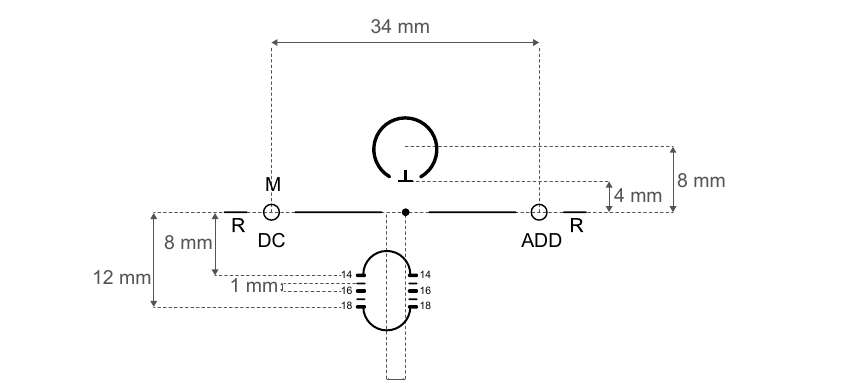
Engraving Index
M = Material DC = Design Code ADD = Addition Power
| Product | Design Code |
|---|---|
| Camber Steady Plus Balance | C+ |
| Camber Steady Plus Distance | C+d |
| Camber Steady Plus Intermediate | C+i |
| Camber Steady Plus Near | C+n |
Design lines
Design lines.
- Camber Plus
Coatings
Coatings.
- Green base – the standard coating
- Blue – optional upgrade
- Gold – optional upgrade
Options
Options.
- Prism (available on one side)
- Lenticular
- High-cylinder option for stronger cylinder powers
Offer Camber Steady Plus in your shop.
Partner with GV, sign in to order, or send us a quick message on WhatsApp.